We Read 966 Job Postings. 'Remote' Means Six Different Things.
We audited 227 self-described remote-first startups. Only 2 actually post jobs without continental restrictions. Here's the taxonomy of what 'remote' really means in 2026.
I’ve been remote since before companies bragged about it. I’ve been a remote-first operator and advocate for years - it’s how I work best, it’s how I think the best teams work, and it’s a hill I’ve spent more job interviews defending than I’d like to count. (Yes, those interviews went about as well as you’d expect.)
So when I tell you the language around “remote-first” has been quietly hollowing out for the last two years, that’s not a hot take. It’s something I’ve been watching pretty closely.
During COVID, the leverage was with employees. Companies were tripping over themselves to advertise how remote-friendly they were because that was how you closed candidates in a market where everyone was hiring. “Remote-first” became a recruiting weapon. Then the layoffs started - late 2023, all through 2024, into 2025 - and the leverage flipped. Suddenly the same companies were walking it back. RTO mandates from the FAANG tier on down. “Hybrid” started showing up in places “remote” used to live. The careers pages still said all the right things, but the job descriptions started reading differently if you actually opened them.
I had a suspicion the word was getting hollowed out. I wanted to know if that was just my vibe, or if it was in the data.
So I pulled 966 job postings from 227 self-described remote-first startups - Seed to Series B, all under 500 people - and ran them through a structured extraction prompt that classifies the location language each one actually uses.
The vibe was right. It’s worse than I thought.
Here’s what stopped me first: 461 of 942 postings are tied to a specific city. That’s 49%. Half the jobs at “remote-first” startups are anchored to a city the candidate has to live in.
Then I aggregated each company by its predominant location language and got this:
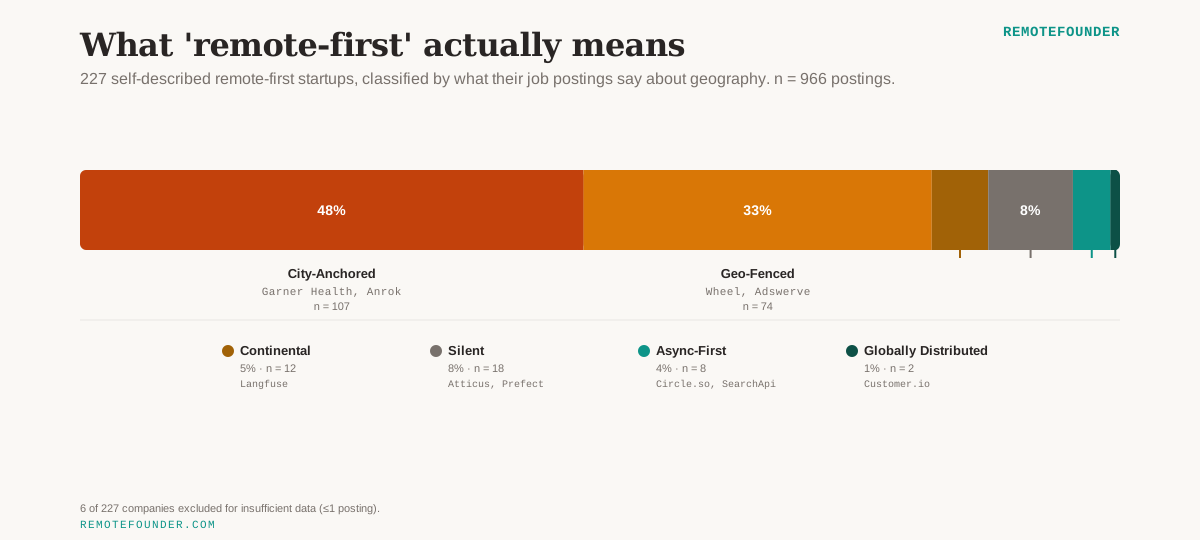
Two companies. Two, out of 227. That’s how many actually post jobs without continental restrictions. And even those two aren’t really “globally distributed” - Customer.io says “Americas Remote,” Maven says “Remote (US time zones preferred).” There are zero companies in the corpus that say “anywhere on Earth.”
Globally unconstrained remote work, at the startup level, is basically extinct in 2026. Almost nobody has noticed, because everyone’s still using the same word for six different things.
So I built a taxonomy. Here’s how the 227 companies break down, walked from “you’re coming to the office” to “we mean it.”
Tier 1: City-Anchored (47.1%, the biggest bucket)
The biggest category is also the most misleadingly named. These are companies whose websites say “remote-first” and whose job postings say “be in our office three days a week.”
Garner Health is the cleanest example. People Operations role, branded remote-first on the careers page, actual posting language:
“This role will be based in our New York City office, 3 days per week on Tuesday, Wednesday and Thursday.”
All five Garner postings in the corpus are tagged hybrid. Not one is actually remote. They’d argue - I think reasonably - that they’re “remote-first with anchors,” meaning they hire remote in some functions but lean in-person for ops. That’s a defensible position. It’s also not what “remote-first” means to a candidate scrolling careers pages at 11pm.
This is the most common mode in the dataset: 107 companies, 47.1% of the corpus. Garner, Anrok, Dandy (4 of 4 postings on-site in Carrollton TX), Luminovo (“remote-first company headquartered in Munich” - 4 of 5 postings hybrid). The pattern is the same. The brand is remote, the jobs are not.
Tier 2: Geo-Fenced (32.6%)
The second-biggest bucket is companies that are genuinely remote - within a country, a region, or a list of approved cities.
The funniest example is Wheel. Director of People Operations role, tagged “remote”:
“Remote USA, Preferred locations include Bay Area, CA, Austin, TX, and secondary locations are Chicago, IL, Atlanta, GA, Boston, MA, New York City, Denver, CO and Seattle, WA.”
That’s a “remote” job that names eight cities. It is, technically, remote. It is also a job that has carefully curated where on the map you’re allowed to live.
Adswerve is more matter-of-fact about it (“Our team of 250+ employees is spread out across 26 states and six countries”). Ada Health does country-pair fencing (“UK or Germany”). Artera stacks visa fencing on top of geo fencing. None of these companies are doing anything wrong - Geo-Fenced is the honest middle path, and 74 companies (32.6%) sit here. But “remote within the US” is a different product than “remote,” and it’s worth giving it a different word.
Tier 3: Continental (5.3%)
Tier 3 is small - 12 companies - and almost entirely European. The pattern is “remote anywhere in EMEA” or “remote within Europe,” sometimes with a periodic pilgrimage requirement.
Langfuse is the exemplar. YC-backed, Series A, calls itself remote-first. Real posting:
“Europe; expect one week per month in our Berlin office.”
All four Langfuse postings are tagged hybrid. The “one week per month in Berlin” is the perfect Tier 3 contradiction - continental remote, with a recurring flight on the calendar. (RoomPriceGenie does the cleaner version - “fully remote within Europe,” no pilgrimage. AssemblyAI and Collabora sit in the same neighborhood.)
Tier 4: Silent (7.9%)
Tier 4 is the trickiest one to write about, and I want to be careful here.
These are the 18 companies whose postings say things like “fully remote and we’re committed to…” or “Remote first company #LI-Remote” - and then never specify where you actually need to live. Atticus, Truffle Security, Prefect, Mento. The temptation is to call this evasive. I don’t think it usually is. Most of these companies just haven’t documented the constraint, probably because the person who wrote the job description didn’t think about it from the candidate’s side of the screen.
But the gap between “we’re remote” and “here’s where we hire” is doing a lot of work. For a candidate, a posting with no location language is either an open door or a closed one - and you can’t tell which from the page. It’s the candidate-experience version of a footnote nobody wrote.
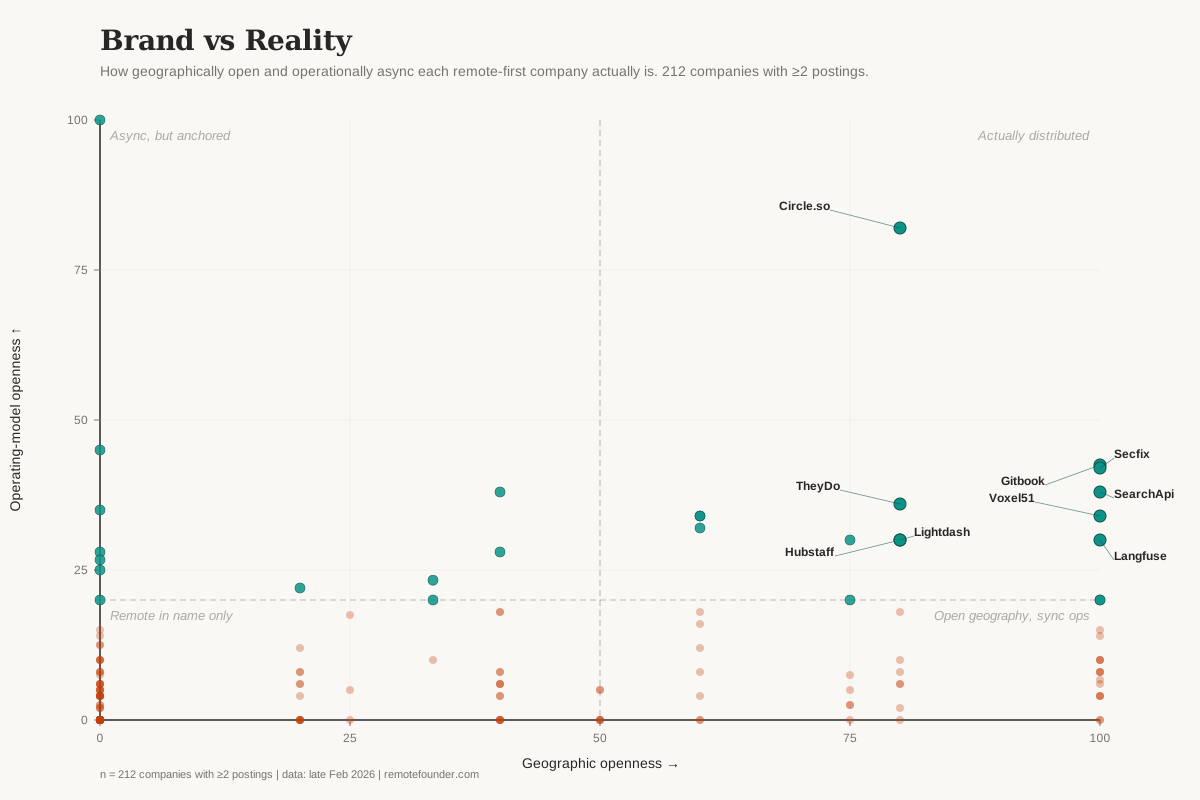
That scatter plot is the same companies (212 of them - the ones with at least two postings each) graphed against two axes: how open they are about geography, and how async they actually sound in their job copy. The bottom-left blob is the “remote in name only” cluster - 99 companies that score essentially zero on both axes. The lone star in the top-right is Circle.so. I’ll get to that.
Methodology (the part where I tell you what could be wrong)
I want to be transparent about how this was built, because the easiest way to get a post like this wrong is to over-trust it.
What we did: pulled 227 self-described remote-first startups (Seed to Series B, under 500 headcount) from the broader RemoteFounder pipeline of 368 companies, restricted to those on Greenhouse, Lever, or Ashby - the three ATS platforms we can reliably extract structured posting data from. For each company, up to 5 recent postings, max 2 engineering roles to prevent eng-heavy companies from dominating. Total: 966 postings, scraped late February 2026. Each posting’s full description got passed through Claude Sonnet 4.6 with a structured extraction prompt that returned a dozen-ish fields - location requirement, timezone language, async signals, office mentions, communication style, the works.
What it isn’t: a measurement of internal culture. A company can write “remote-first” and still RTO. A company can write “must be in Boston” and run a wonderful async culture inside. Job posting language is a leading indicator, not a guarantee.
What’s likely wrong:
- Sample bias toward Greenhouse/Lever/Ashby. The ~141 companies on BambooHR, Personio, Workable, Workday, and custom ATS platforms aren’t in this sample. There’s a real chance that cohort skews differently. I don’t know which way.
- The 5-posting cap. A company with 50 open roles got 5 of them sampled. The sample is biased toward whatever was at the top of their board on scrape day.
- The Silent tier is partly an artifact of classification. When the extraction came back “no location stated,” I counted the company as Silent. Some of those postings are genuinely unconstrained. Some are just… not specifying. I can’t reliably tell the two apart from text alone.
- It’s a snapshot. Late February 2026. Some of these have updated their pages since.
This is also a snapshot of a specific moment - late February 2026, two-plus years into a layoff cycle that’s reshuffled the leverage between employers and candidates. The numbers above are what the hollowing-out looks like in the data.
What I’d trust: the named quotes. If a company is called out by name in this post, the quote is verbatim from their actual public job listing. You can search for it.
Tier 5: Async-First (3.5%, the closer)
There’s one tier I haven’t gotten to yet, and it’s the only one that gives me any hope.
Eight companies in the corpus aren’t sorted by where they hire - they’re sorted by how they work. Circle.so is the exemplar at the structural level: “fully remote company of around 200 team members from 30+ countries around the world.” 200 people, 30+ countries. They’re the lone outlier in the top-right of that scatter plot for a reason - by far the highest combined geographic-and-operational openness score in the dataset. TheyDo is similar (27 countries, 30+ nationalities). Secfix is more honest than most: “Remote, +/- 2hrs from Germany GMT+1, Europe.” They constrain by timezone, which is a far more candidate-useful thing to constrain by than a list of cities.
But the company that nailed it in twelve words is SearchApi. Buried inside one of their actual job postings:
“Remote-first means if you can’t write clearly, you’ll struggle.”
That’s the whole post. Twelve words. The other 226 companies in this dataset spent thousands of words on culture statements and remote philosophy and “we believe in flexibility” - and not one of them said the actual thing: remote-first is a writing-driven operating model, and if you can’t write, the model doesn’t work for you.
I read 966 job postings looking for the company that gets it. SearchApi is the one I found.
Data behind this post: 966 postings, 227 companies, late February 2026. If you run a remote-first startup and your job postings don’t sound like the tier I put you in - I genuinely want to hear about it.
Get more like this
One tactical deep-dive for remote-first founders. No lifestyle fluff.